Toenails grow about 1.62 millimetres a month. That one number explains why most foot fungus routines get abandoned too early.
We transcribed Blinzador's actual product label, opened every research link the company publishes, and checked its active ingredient against the FDA's own over-the-counter antifungal monograph. The active ingredient is genuinely FDA-recognised. Two of the seven study links matched the product; five did not. And the label declares fifteen ingredients where the website lists five — with two tree nuts among the ten it leaves out. Here is what held up, what did not, and what the offer actually costs once shipping is counted.
This product has not been evaluated or approved by the U.S. Food and Drug Administration, and is not intended to diagnose, treat, cure or prevent any disease. Undecylenic acid appears in the FDA's over-the-counter antifungal monograph; that is recognition of the ingredient, not FDA approval of this product. Nothing on this page is medical advice. For adults aged 18 and over. Individual results vary and no outcome is promised. Nail changes can have causes other than fungus — consult a licensed physician or pharmacist before use, particularly if you have diabetes, circulation problems or a weakened immune system, or are pregnant or breastfeeding.

The arithmetic nobody puts on the label
Here is the part that reframes everything else on this page.
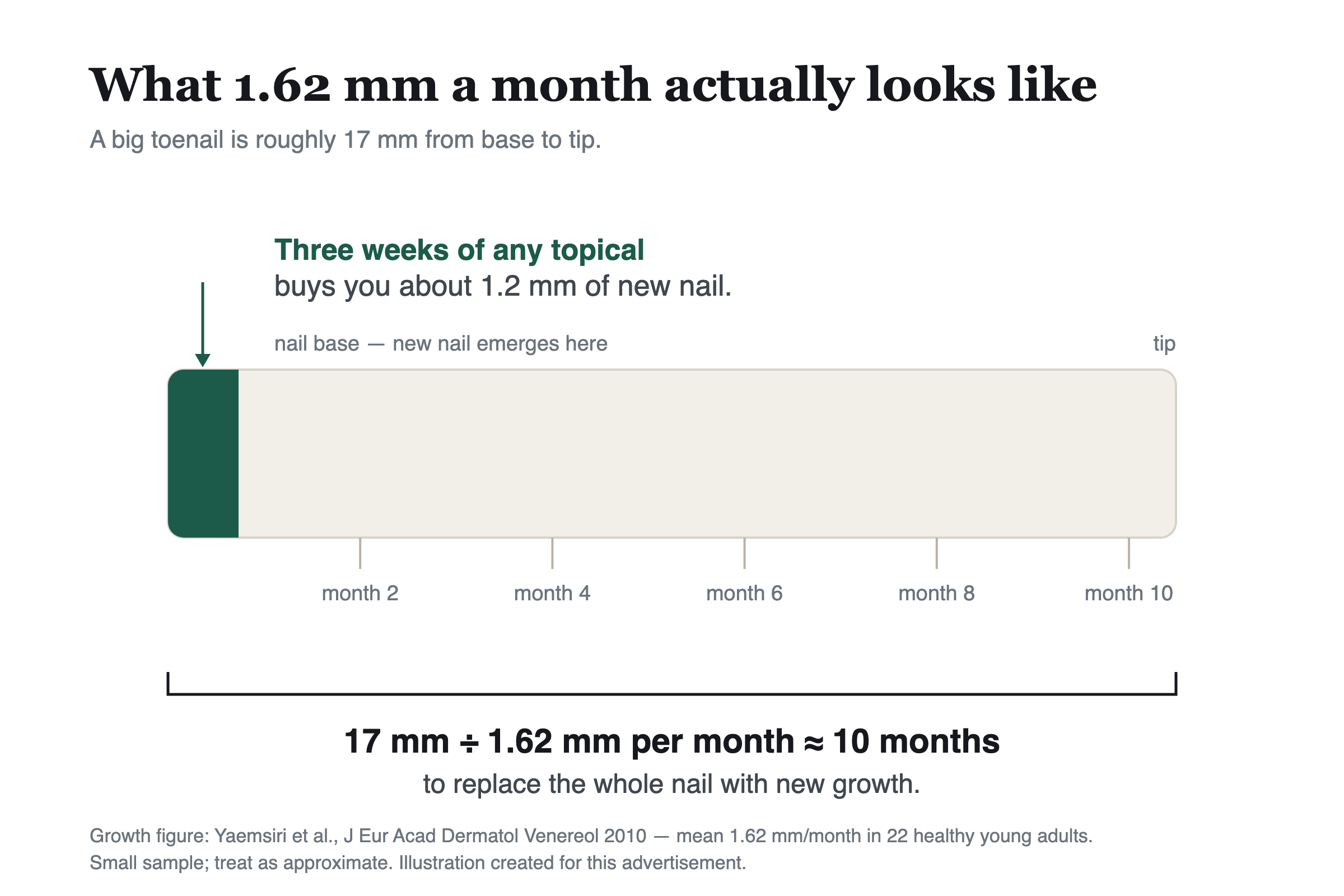
In a study of 22 healthy American adults published in the Journal of the European Academy of Dermatology and Venereology, toenails grew an average of 1.62 mm per month — less than half the rate of fingernails (Yaemsiri et al., 2010). It was a small study of young adults, so treat it as a rough figure rather than a law. But the order of magnitude is what matters.
A big toenail is roughly 15 to 20 mm from base to tip. At 1.62 mm a month, the nail you are looking at today takes the better part of a year to be fully replaced by new nail growing out from the base.
Read that again, because it has a consequence most people never hear:
Why "it didn't work" is often "it didn't finish"
A topical product works on the nail surface, the nail edge and the surrounding skin. It cannot repair the part of the nail that has already grown out damaged. That part has to grow off. So the visible improvement people are waiting for is new nail — and new nail arrives at roughly 1.6 mm a month, whatever you spray on it.
Someone who applies a product for three weeks, sees an unchanged nail, and concludes it failed has not actually run the experiment. They have measured about 1.2 mm of it.
This is not a claim about Blinzador. It is a claim about nails, and it is true of every topical on the shelf. But it is the single most useful thing to understand before you spend money on any of them — including this one.
The second thing: you are not only treating a foot
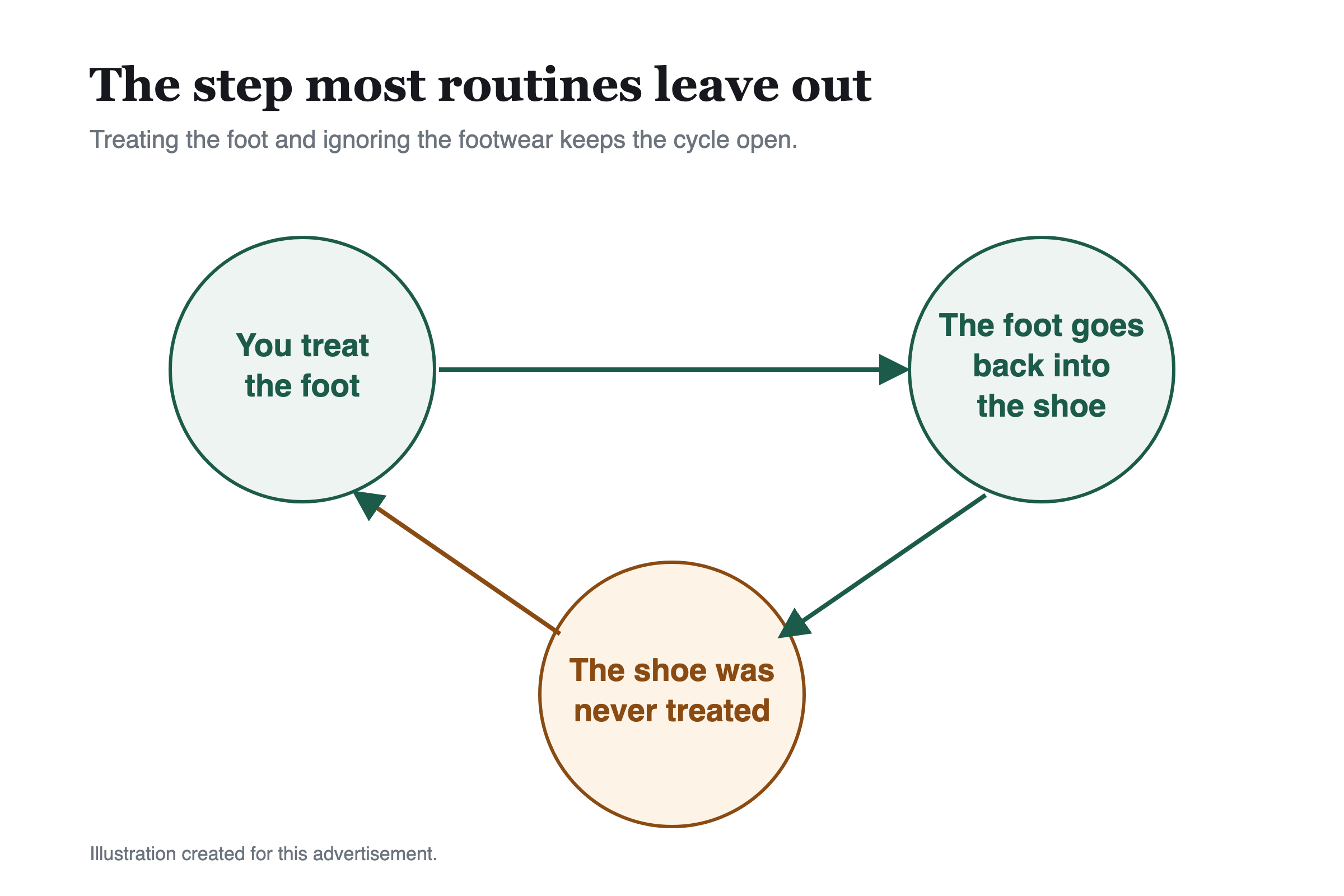
Fungi that affect feet do not live exclusively on feet. They persist in the places feet go — the inside of shoes, socks, bath mats, shower and locker-room floors. Which sets up a loop that has nothing to do with how good your product is:
- You treat the foot.
- The foot goes back into the shoe.
- The shoe was never treated.
This is why the most genuinely useful thing in Blinzador's larger packages may not be the extra bottles. It is the bonus guide the company includes, Silent Spreaders: Hidden Fungus Hotspots in Your Home — a topic that most sellers in this category ignore entirely, because it is not a thing you can put in a bottle. We have not read the guide, so we cannot review its quality; we are pointing out that the company chose to address the loop at all.

What the active ingredient actually is
Blinzador's antifungal ingredient is undecylenic acid. This is worth knowing, because it is not a novelty ingredient invented for a landing page.
Undecylenic acid is one of only seven active ingredients the U.S. Food and Drug Administration recognises for over-the-counter antifungal drug products under its monograph at 21 CFR 333.210. You can read the regulation yourself — the list is short and undecylenic acid is item (f):
"Undecylenic acid, calcium undecylenate, copper undecylenate, and zinc undecylenate may be used individually or in any ratio that provides a total undecylenate concentration of 10 to 25 percent."
That is a real regulatory fact, and it puts this ingredient in a different category from the botanical blends that dominate this market.
And here is the honest limit of that fact
The monograph specifies a total undecylenate concentration of 10 to 25 percent. We went and read Blinzador's own label image, published on its site. No concentration is printed on it.
What the label does show is that undecylenic acid is listed second, after mineral oil. Under standard ingredient-order conventions, components above one percent are listed in descending order by weight — so it is the most abundant active component in the bottle. That is encouraging. It is also not a percentage: "second by weight" is equally compatible with three percent and thirty.
So: the ingredient is FDA-recognised for this use, and it is present in a meaningful position on the list. We cannot tell you the formula sits inside the monograph's 10–25% range. If that matters to you — and it reasonably might — email the company and ask for the percentage before you order. A company with a compliant formula has no reason not to answer. The label gives support@blinzador.com; the website routes you through its contact page. Try both.
The website lists five ingredients. The label lists fifteen.
This is the part of our reading we least expected, and it is the reason we would tell a friend to read this page before buying rather than after.
Blinzador's website has a tidy ingredient section with five entries: undecylenic acid, lavender oil, jojoba oil, menthol and vitamin E. The company also publishes a photograph of the actual product label. We enlarged it and transcribed the ingredient declaration in full. Here it is, verbatim, in label order:
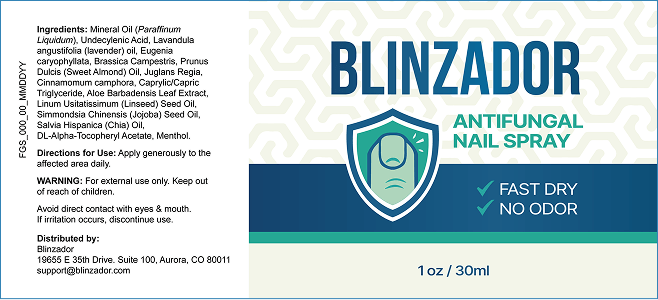
"Ingredients: Mineral Oil (Paraffinum Liquidum), Undecylenic Acid, Lavandula angustifolia (lavender) oil, Eugenia caryophyllata, Brassica Campestris, Prunus Dulcis (Sweet Almond) Oil, Juglans Regia, Cinnamomum camphora, Caprylic/Capric Triglyceride, Aloe Barbadensis Leaf Extract, Linum Usitatissimum (Linseed) Seed Oil, Simmondsia Chinensis (Jojoba) Seed Oil, Salvia Hispanica (Chia) Oil, DL-Alpha-Tocopheryl Acetate, Menthol."
Fifteen ingredients, not five. Ten of them appear nowhere in the website's ingredient section. Most of the omissions are unremarkable carrier oils. Two of them are not.
If you have a tree nut allergy, read this before you buy
The label declares Prunus dulcis — sweet almond oil — and Juglans regia — walnut. Both are tree nuts.
Neither appears in the five-ingredient list on the website. Someone with a tree nut allergy who read only the website would have no way of knowing they were about to spray almond and walnut derivatives onto their skin twice a day.
We are not aware of any allergen warning on the packaging, and we did not find one on the site. If you or anyone applying this for you has a tree nut allergy, do not buy this product without speaking to a doctor or pharmacist first. This is the single most important sentence on this page, and it is worth more to you than the discount.
Two other label ingredients are worth naming, because they carry ordinary precautions that a five-item list does not prompt you to think about:
- Eugenia caryophyllata (clove) — a well-known contact sensitiser. Some people react to it on the skin.
- Cinnamomum camphora (camphor) — routine in topical products, and exactly why the label's "keep out of reach of children" and "avoid direct contact with eyes and mouth" warnings are on there. Follow them.
The label's own instructions and warnings, in full: "Apply generously to the affected area daily. For external use only. Keep out of reach of children. Avoid direct contact with eyes & mouth. If irritation occurs, discontinue use." Each bottle is 1 oz / 30 ml.
One more detail from the label worth knowing: it says "Distributed by: Blinzador." Distributed, not manufactured. Who actually makes the formula is not disclosed on the label or the website.
The research links: two out of seven
Blinzador publishes a reference section with seven PubMed links. We opened all seven. Only two are about the product's ingredients. We are showing you both lists, because the difference is the most informative thing on the page.
| Reference | What it is actually about | Matches an ingredient? |
|---|---|---|
| PMID 10991877 Antimicrob Agents Chemother, 2000 |
Undecylenic acid inhibits morphogenesis of Candida albicans. Laboratory study. | Yes — the active ingredient |
| PMID 19697345 Chem Biodivers, 2009 |
Chemical composition and antifungal activity of Lavandula pedunculata essential oils. Laboratory study. | Yes — lavender oil |
| PMID 27011254 | PubMed returns no record for this identifier. | No — dead reference |
| PMID 21292892 | Isolation and phylogenetic analysis of Batai virus, Germany. | No |
| PMID 20795835 | Interprofessionalism and shared decision-making in primary care. | No |
| PMID 11305255 | Allium chemistry: selenocysteines and their derivatives. | No |
| PMID 25634952 | Characterisation of Desulfovibrio biadhensis, a bacterium from a thermal spring. | No |
We are not going to guess why five unrelated papers are on that list. We will simply not use them. Everything we say about ingredients on this page rests on the two that match, plus the FDA monograph above.
What those two studies do and do not show
Both are laboratory studies. They describe how an ingredient behaves in a controlled setting — undecylenic acid interfering with a yeast's morphogenesis, lavender oil showing antifungal activity against tested organisms.
A laboratory result is not a treatment outcome. It does not demonstrate what will happen on your foot, and neither study tested this finished product on people. Note also that Candida albicans is a yeast; many foot and nail infections involve dermatophyte fungi instead. We are showing you the ceiling of this evidence, not stretching it.
All fifteen, sorted by what they actually do
| Ingredient | What it is doing | Note |
|---|---|---|
| ★ Mineral oil | The base the whole spray sits in | Listed first, so it is the bulk of the bottle. Worth knowing if you dislike an oily film, and it is why "fast dry" is a claim we would want to test rather than assume. |
| Undecylenic acid | The antifungal ingredient | FDA-recognised OTC antifungal active (21 CFR 333.210(f)). Second by weight. Concentration not printed. |
| Lavender oil | Antimicrobial, and the scent | Laboratory antifungal activity documented for Lavandula oils. |
| ★ Clove (Eugenia caryophyllata) | Aromatic, antimicrobial traditionally | Known contact sensitiser. Omitted from the website. |
| ★ Brassica campestris | Carrier oil (rapeseed/field mustard) | Emollient. Omitted from the website. |
| ★ Sweet almond oil (Prunus dulcis) | Carrier oil | Tree nut. Omitted from the website. |
| ★ Walnut (Juglans regia) | Carrier oil | Tree nut. Omitted from the website. |
| ★ Camphor (Cinnamomum camphora) | Aromatic, cooling | Carries standard precautions. Omitted from the website. |
| ★ Caprylic/capric triglyceride | Lightweight carrier | Standard cosmetic emollient. Helps the spray feel less heavy. |
| ★ Aloe leaf extract | Skin conditioning | Emollient. Omitted from the website. |
| ★ Linseed oil | Carrier oil | Emollient. |
| Jojoba seed oil | Nourishing, hydrating | Emollient. Helps the skin around the nail — not an antifungal. |
| ★ Chia oil | Carrier oil | Emollient. |
| Vitamin E (DL-alpha-tocopheryl acetate) | Antioxidant | Protects the oils in the bottle from going rancid. No antifungal role. |
| Menthol | Cooling sensation | Produces a feeling. That feeling is not evidence the product is working. |
Sorted honestly, that is one antifungal ingredient, two aromatic botanicals with some laboratory support, and twelve oils, emollients and a preservative antioxidant.
We do not mean that as a takedown. It is a fair description of most topicals in this category, and the delivery vehicle genuinely matters here: a spray that dries reasonably fast, smells of lavender rather than medicine, and reaches between the toes without you bending down and touching the area — which is not a small thing at seventy — is the product you will still be using in month eight. And month eight is when the nail finally shows you the answer. Compliance is the whole ballgame in a condition measured in millimetres per month.
What we object to is not the formula. It is publishing five of fifteen ingredients and leaving the two tree nuts in the other ten.
What we could verify, and what we could not
Verified
- Undecylenic acid is an FDA-recognised OTC antifungal active ingredient.
- Two of the company's cited studies genuinely concern its ingredients.
- A full U.S. street address is published: 19655 E 35th Drive, Suite 100, Aurora, CO 80011.
- Privacy policy, terms, refund and shipping pages all exist and load.
- We opened the actual order page for all three packages and confirmed the charged totals: $167.99, $207.00 and $294.00, with shipping shown as $9.99 on the smallest and $0.00 on the other two.
- The retailer of record is named at checkout — BuyGoods Inc., Wilmington, Delaware — with a support phone line and the statement descriptor disclosed.
- The 180-day money-back guarantee is stated on the order page itself.
- The site carries the required FDA disclaimer.
Could not verify, or does not add up
- The concentration of undecylenic acid. Not on the label, not on the site.
- The website's ingredient list is incomplete — five entries against fifteen on the label, and the omissions include two tree nuts.
- No Drug Facts panel. The label carries a cosmetic-style ingredient declaration, with no "active ingredient" line and no percentage — yet the packaging reads "antifungal nail spray," which is a drug claim.
- "4.92/5 from 39,208 reviews." We found no page where those reviews can be read or independently audited, so we do not repeat that figure as fact.
- Who makes it. The label says "distributed by," not manufactured by.
- Two different support addresses are published — one on the label, one on the site — and orders placed through this page go through a third party again, BuyGoods, with its own support line. Know which one to contact: the one that took your money.
- Whether the published customer statements were compensated or incentivised.
- The crossed-out "was" prices. We cannot confirm those were ever the charged price.
- The contents or authorship of the bonus guides.
What the company's own customers say — and how to read it
Blinzador publishes signed customer statements on its site. We are reproducing the substance of them rather than dressing them up, and we are labelling them accurately:
The company publishes five-star statements attributed to John, Emily, Robert and Sophia, describing satisfaction with the spray's ease of use, fast drying and lack of odour.
Disclosure required, and given: these are statements published by the seller, not by us. We did not collect, contact or verify them. We do not know whether the people quoted received free product, a discount or payment. Individual results vary and these are not typical results. Treat them as marketing material — which is what they are, and what this whole page is.
Before you buy: when this is the wrong purchase
Please take this section seriously. It is the part an advertisement usually leaves out.
- Do not use it if you have a tree nut allergy without medical advice. The label declares sweet almond oil and walnut. The website does not.
- See a licensed clinician first if the nail is painful, separating from the nail bed, spreading, or if you are unsure what the discoloration is. Several conditions look like fungus and are not.
- If you have diabetes, peripheral circulation problems, or a suppressed immune system, do not self-treat a foot problem. Foot complications in these groups are managed medically for good reason. Speak to your doctor or podiatrist before using anything, including this.
- Do not use it on broken skin or on an area that is weeping, bleeding or inflamed without medical advice.
- Stop and seek advice if the skin becomes irritated. This formula contains lavender oil and menthol; both can irritate sensitive skin.
- Nail changes can have non-fungal causes — including injury, psoriasis and other conditions. An antifungal will not help those.
This product is not a cure and is not a treatment for any disease. Nothing on this page is a diagnosis or a substitute for professional medical care.
What it costs, stated straight
Every figure below was read on the live order page. We left out the crossed-out “was” prices the site displays, because we cannot verify those were ever charged.
This product has not been evaluated or approved by the U.S. Food and Drug Administration and is not intended to diagnose, treat, cure or prevent any disease. For adults 18 and over. Individual results vary; no outcome is promised. The label declares sweet almond oil (Prunus dulcis) and walnut (Juglans regia) — both are tree nuts. Do not buy it if you have a tree-nut allergy. Consult a physician or pharmacist before use.
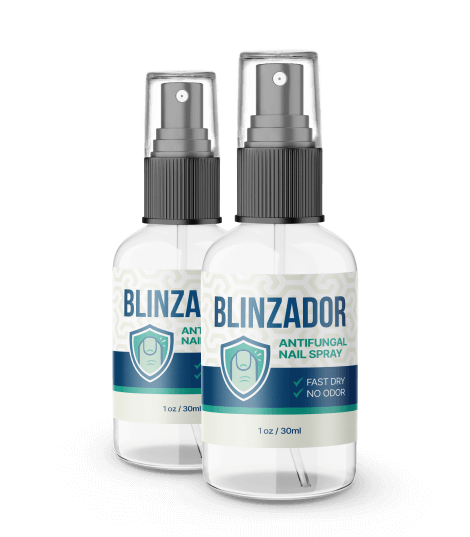
2 bottles · 60-day supply
$167.99
$158 product + $9.99 shipping
$2.80 per dayShipping not included — $9.99 added at checkout
- No bonus guides.
- 60 days of product — shorter than the time a nail needs to grow out.
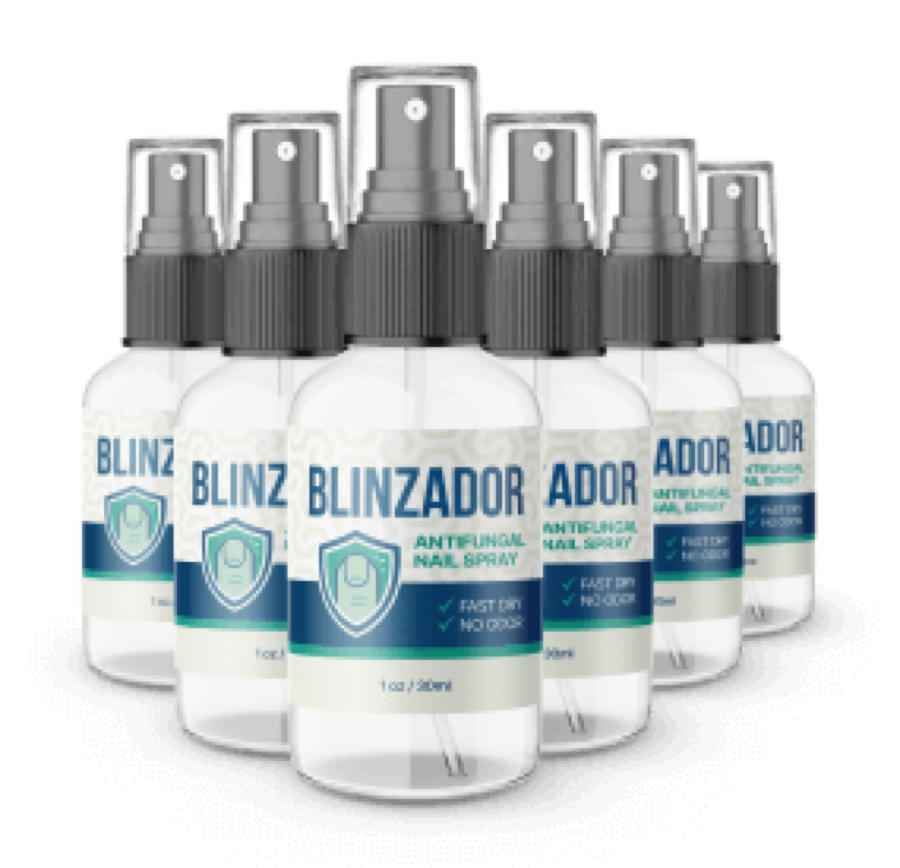
6 bottles · 180-day supply
$294
$49 per bottle
$1.63 per dayFree U.S. shipping
- 42% less per day than the 2-bottle package, once its shipping is counted.
- 3 bonus guides, including the footwear and household guide.
- 180 days of product — the only length that matches both the biology and the seller's 180-day money-back window.
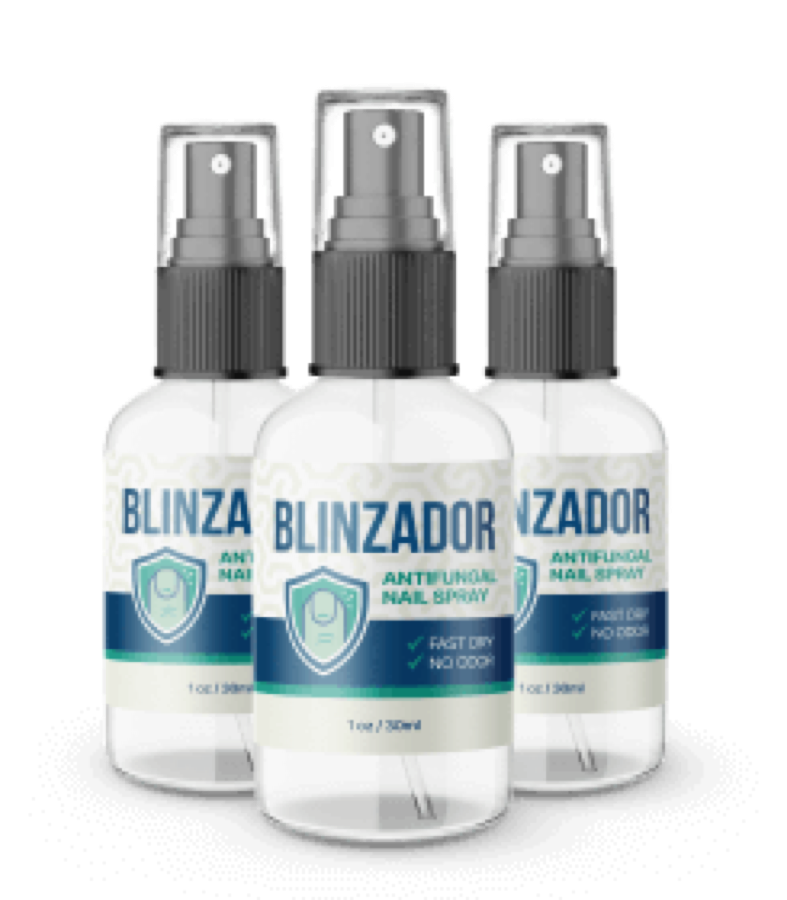
3 bottles · 90-day supply
$207
$69 per bottle
$2.30 per dayFree U.S. shipping
- 1 bonus guide.
- Checkout shows $0.00 shipping and $207.00 total.
Orders from this page are sold and fulfilled by BuyGoods Inc., 1000 North West Street, Suite 1200, Wilmington, DE 19801, the retailer of record; the charge appears on your statement as “BuyGoods”. The product is branded by Blinzador, 19655 E 35th Drive Suite 100, Aurora, CO 80011. The checkout shows your final total, including shipping and any tax, before you confirm — and it also offers an optional $19.95 priority shipping upgrade, a separate add-on not included in any total above. Prices are set by the seller and can change without notice. The author of this page earns a commission if you buy.
The guarantee: 180 days
This is the part of the offer we expected to be weakest and found to be strongest.
The order page carries a 180-day money-back guarantee, stated on the checkout itself as "180 days no questions asked money back guarantee." We are quoting the seller's own promise at the point of sale, and we checked it on the live order page rather than repeating a claim from the sales copy.
Why the length of that window is the whole point
Go back to the arithmetic at the top of this page. A toenail grows about 1.62 mm a month, and a big toenail is 15 to 20 mm long, so a full replacement takes the better part of a year. Almost every guarantee in this category runs 30 or 60 days — which expires long before the nail can show you anything.
A 180-day window is the first one we have seen in this category that is longer than the time the biology actually needs to answer the question. It is also exactly the length of the 6-bottle supply. Those two numbers lining up is the single most useful thing about this offer.
Read the terms in full before ordering: BuyGoods refund policy · Blinzador shipping policy. Refund requests go through BuyGoods, the retailer of record, at support@buygoods.com or 302-404-2568.
The one-paragraph summary, if you skipped to the end
First, the one that matters most: the label declares sweet almond oil and walnut — two tree nuts — and the website's ingredient list does not. If you have a tree nut allergy, stop here and talk to a doctor or pharmacist.
Beyond that: Blinzador is built around undecylenic acid, an ingredient the FDA formally recognises for over-the-counter antifungal use, and it sits second by weight on the label — but no concentration is printed and there is no Drug Facts panel, so ask for the percentage before you buy. Its research section is padded with five irrelevant papers, which is a mark against its marketing rather than its formula. Its "39,208 reviews" figure is not auditable and we do not repeat it. Nails grow at roughly 1.62 mm a month, so any topical needs months rather than weeks — which makes the 180-day package the only one whose length is honest about the timeframe, and at $1.63 a day the cheapest way to run the test. The order page carries a 180-day money-back guarantee, the first one we have seen in this category that outlasts the nail. Talk to a clinician first if you have diabetes, circulation problems, or a nail that hurts.
Questions worth answering
How long until I see something?
Honestly: longer than you want. The skin between the toes can respond sooner, but the nail cannot look different until new nail grows out, at roughly 1.62 mm a month. Anyone promising you a visibly different nail in two weeks is describing something nails do not do. Blinzador's own marketing language about acting from the first spray is, in our reading, overstated for that reason, and we have not repeated it.
Is this a drug or a cosmetic?
The label points one way and the packaging points the other, and we cannot resolve it for you. The front of the bottle reads "antifungal nail spray" — that is a drug claim. But the back carries a cosmetic-style ingredient declaration: one continuous list, no "active ingredient" line, no percentage, no Drug Facts panel of the kind an over-the-counter antifungal drug would normally carry. The website then adds the supplement-style disclaimer ("has not been evaluated by the Food and Drug Administration… not intended to diagnose, treat, cure, or prevent any disease"). Three signals, three different regulatory categories. If the status matters to you, ask the company before ordering — and treat a non-answer as an answer.
Do I have to treat my shoes too?
It is the part of the routine most people skip, and skipping it is a plausible reason a routine stalls. The larger packages include a bonus guide on exactly this. Washing socks hot, rotating shoes so each pair dries fully, and not walking barefoot on shared wet floors cost nothing and are worth doing regardless of what you buy.
What if it does nothing for me?
Then use the 180-day money-back guarantee on the order page, and start the request inside the window rather than after it. Refunds are handled by BuyGoods, the retailer of record, not by Blinzador: support@buygoods.com or 302-404-2568. The full terms are in the BuyGoods refund policy, and it is worth reading them before you order rather than after — that is true of every guarantee, including a generous one.
Who wrote this and who gets paid?
This page was produced by an affiliate marketer who receives a commission on sales made through the links above. That is a financial interest, and it is why we have shown you the failed references, the missing concentration, the unverifiable review count and the conditions on the refund. You should weigh the commission when you weigh the recommendation.